addition to pruning aesthetic value to the plant, to save space or make it more productive can reduce the effects of certain diseases, so sometimes it is not only desirable but also necessary to intervene for the good health of the plant.
order to perform pruning we must first become familiar with some terms related to the different parts of the plant and to run before it must acquire basic knowledge and that no support pruning scale of "amateur "that may directly or indirectly cause the death of the plant.
different parts of a plant:
- Skeleton: is formed by the trunk and main branches.
-Trunk: is the woody stem from the neck , born about the roots and branches fork. Also called central axis.
-Footer: trunk is the portion near the neck, ie just above ground level.
-primary branches: branches are inserted directly from trunk
secondary -Ramps: are the branches that are inserted in the primary. Also called sub-branches.
-tertiary branches: are the branches that are inserted into the secondary can be first, second, third order, etc., Depending on the distance to the source of the media industry.
fruitful -Twigs: young branches are inserted into the branches. Are renewed by pruning for productive purposes.
-Dorsal: (one branch) is facing the the ground.
-Ventral: (one branch) is the part directed towards the ground.
-Arrow: extension of a branch particularly evident through the development of the bud.
-fork or shelf: of branches inserted at the same height on the trunk:
- Baja - insertion of 30 to 60 cm of soil.
- Media - insertion of 80 to 120 cm of soil.
- High - insertion of 150 to 180 cm of soil.
Objectives of pruning:
Depending on what you want to get the pruning operations includes some performances, from a simple incision to the full court trunk.
- Distribute the branches of a uniform building space and sun to bloom and the fruits are of a regular size and color.
- Contain and resize the crown development delaying aging plant
- Stop vegetative vigor because it is inversely proportional to both flowering and fruit production. Get
- early production, and quality abundande staggered and prolonged. Develop
- Cup as the most suitable for your design or production possibilities in terms of environmental factors.
Effects:
different operations pruning is necessary, useful or contraindicated depending on the type of planting ornamental and fruit on with the function you wish .. Sp each reacts differently to the same interventions so they need a proper techniques.
The domain of the apex.
If
we cut a branch, the bud was more close to it wakes up and emits an outbreak. The yolk exercised dominion over the next bud delayed or prevented their development and to cut the negative influence disappears. This domain is less pronounced is sp that branch of shrub arrangement spontaneously. Are given in the main trunk and secondary branches.
General Regulations.
- The cut should be made with the tools sharp and consistent with the diameter of the branch.
- The cut should be made easily without crushing, chipping or nicks. Before removing the nucleus of the branch is necessary that the bark is cut to avoid injury difficult to heal.
-cut surfaces of more than 3 cm is recommended to protect them with scar putty. Conifer species do not require any application, but other substances which emit nest fungi and bacteria (drupaceous).
-cutting should be done by encouraging the development of the industry in the desired direction. This is achieved by cutting the branches according to the position of the buds.
-tilted position is cut away from the insertion point of the yolk, just above but not too close to not cause injury to its surrounding tissue. Cutting too far from a bud or between a stump out in the absence of any element that can be developers.
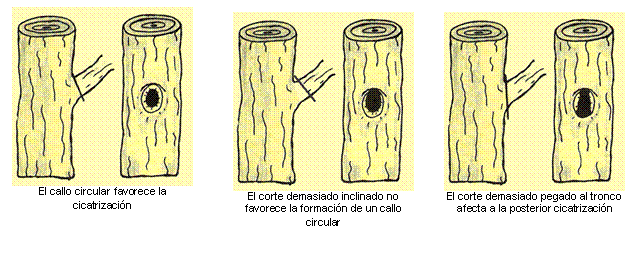
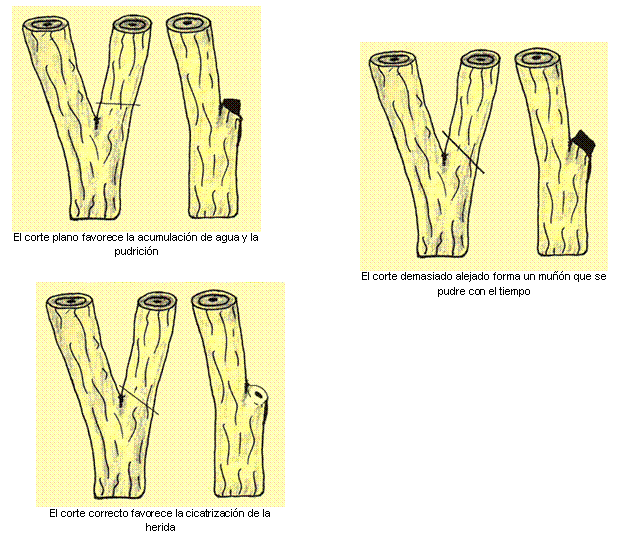
buds.
trimming to get the desired effects is necessary to recognize the types of buds, distribution and processing capabilities.
of traits:
Woody: Fine and acute lead to an outbreak on elongating herbaceous be lignified and leads to a small branch.
flower or fruit: Larger than the woody, globular shaped and give rise to flowers. They can be single, double, triple and quadruples.

Mixed: have characteristics intermediate to the above and give rise to branches and flowers.
According location:
Apical: Located at the end of a branch
Side: They are along a branch, coinciding with the knots, swollen ring at the stage of an outbreak.
Terminal: is a full side is to be found in the apex court after the latter.
Axillary: is in the axil of a leaf or bud on your insertion point.
According level of development :
Early: develops in the same year that has been formed and gives rise to an industry that can be considered early pruning in the same season or next winter.

Overnight (hibenante): newly formed and destined to evolve next year. If stimulated by pruning or grafting prior to rest (July-August) may evolve and lead to early bud (early branches).
Latent: can remain for years but to make a pruning operation can awaken.
Adventitia: Located in unusual items can be useful for the development of an outbreak in the desired position.
Branches (distinction based on the buds)
Parquet: woody buds are just
Hijuelos or snakes: vigorous branches produced by the roots or base the trunk.

Pacifiers: Ramifications vigorous, upright, with long internodes, inserted in the trunk or main branches. Branches are woody and only emerge through adventitious or dormant buds.
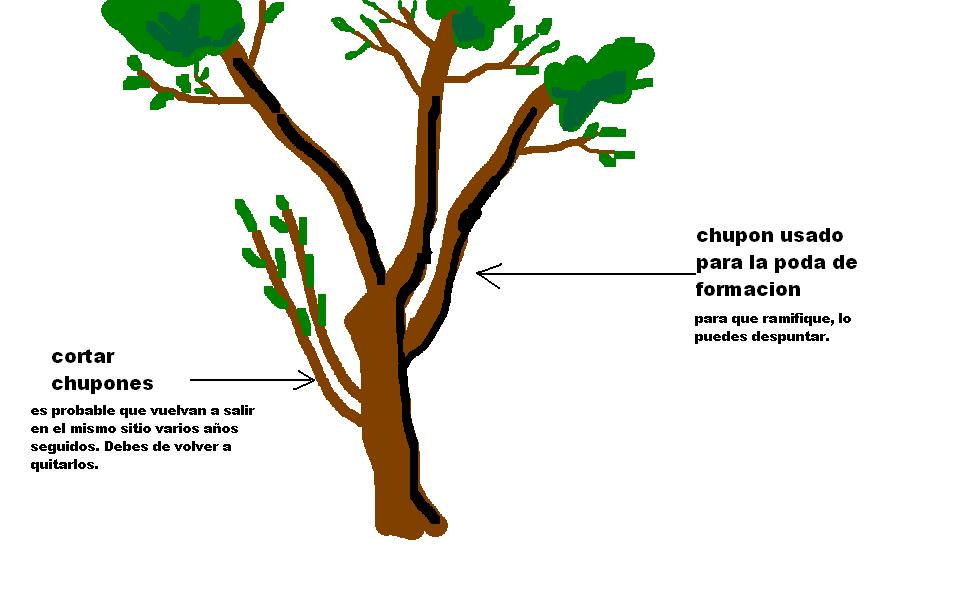
Darts: short and rough formations that evolve (sometimes after 2-3 years) wearing flower buds (lamburdas, May bouquet)
fruit: They only flower buds and divided into 4 groups.
Outbreak: formations are typical of pome short with apex yolks mixed. Engrosamienta and evolution derived from yolk apex darts.
Bags: pome also are typical of the short training resulting in thickening of the twig that bears the flower. Bouquets
May: Typical of the short training pome are provided with lateral flower buds and finished in a shoot apex woody

Crow's feet: Typical pear and consist of a bags and set flower buds.
Mixed: They both flower buds, wood and mixed.
brindillas: fine branchlets which become woody buds flower buds.

Pruning in stations
In
perennial vegetative activity is recognized by the presence of buds and new leaves. Choosing the period in which to carry out interventions can regulate the behavior of what you are looking to achieve.
- Winter or dry. was done during the resting phase of the plan and purpose of exercising a positive influence on the formation of the hairpin of young trees, replacement of glass and old adults as well as the transformation of numerous flower buds. Deleting a branch lightens the drink and if you cut it thickens. In general terms can intervene during the dormant but the best time depends on the weather: mild climates prune in winter, weather stiff right after the fall of leaves. Interventions about spring awakening have a marked and rapid stimulus but runs the risk of frost occurrence and buds abort and impair the production.
- Summer or pruning. activity is practiced in full vegetative and debilitating effects to stop or weaken the excessive force for the following year. If done before summer's over stimulates the formation of new flower buds. Is effective in drupaceous.
Technical
-Trim: pruning intervention that is to eliminate apical portion of young branches from 20 to 30cm to encourage side branches. Premature branches are obtained with hibernating buds destined to develop the following year. It is very useful for the formation of the cup.
- Pruning suckers: pruning that consists in the systematic elimination of outbreaks of 10cm maximum arising from the trunk and branches to become suckers (vertical branches without buds)
- Espolonadura: Cutting a branch near the base, leaving a spur of 2 or 3 buds (short pruning)
- Deschupadora: Remove twigs and branches that arise from the roots or base of the plant and weaken them.
- Pollard and Pollard o: occurs when you delete a drink to rejuvenate the plant causing the sprouting of new branches.
. Thinning: Intervention vine pruning to remove branches from the base into vigorous young plants to reduce the cup.
- Cutting back: pruning to contain development of plants in 2 or more branches years by cutting the arrow (vigorous extension of the trunk or secondary branches) just above a lateral bud.
- Browsing or peel: Removing dead branches, weak or damaged by disease or weather.
- Pruning transplantation: roots are reduced or the drink at the time of transplantation to balance the two sides. Also the roots are cut or broken little interest.
Other deficiniciones:
long-Pruning: c hen industry is only trimmed.
-cut Pruning: when the branch is shortened to a few buds
- Pruning poor: when reduced considerably the number of buds.
- Pruning rich: technique to maintain abundant buds.
Techniques alternatives:
tilt, fold, bend, to slow the ascent of sap to the apex of branches counteracting strong control over the tips below. The angle is tilted beyond the branch without the horizontal line in the folding arm is tilted towards the ground. In the curve bends downward branch arched.
Court: is practiced at the base of a thick branch to tilt or bend to avoid breakage. It cut its back half of the diameter and bends down. Welding due to the sheer weight of the branch to join lips.
inverted V incision: inverted V cut on the tip to stimulate it to have a more to wise up.
Incision: Court in the crust beneath a bud to stem the flow of sap down.
girdling : is removed a ring of bark 5 mm in height to avoid the drop of sap and stimulate flowering and fruiting.
Torque: to hinder the movement of sap in vegetation too young fruit fructifciación stimulating.
thinning of flowers and small fruits: To prevent the fall of flowers and fruit formation. It favors the size and maturity of the fruit. Failure to do next year will roduce a weakening and not produce fruit or produce very few. Old fruit trees is sometimes given a magnificent flower to be reduced or canceled in order to regenerate the tree. When there is not thinned alternate bearing (one year of heavy production load-discharge and another - producing zero or near zero).

Pruning in the three plant ages (stages)
To apply pruning is necessary to separate the life cycle of plants, fruiting
- - Phase youth (training): the plant grows to form the structure but does not pay. In this phase the objectives are to form a skeleton with a regular and definite harmonious development throughout the crown and promote rapid development of the plant without force, since this reduces the production and quality cut so sparingly so as not to encourage excessive force.
- - madrurez phase (production / fruiting): Some buds evolve neutral or mixed flower buds. Start of production while actively maintaining vegetative growth. The objectives of this are to renew the branches of fruit and keep production close to the first structure so that the tree does not grow excessively in height and diameter. This pruning should be light in sp vigorous and more intense in weak sp.
- - phase aging (rejuvenation) In this phase the renovation of the glass is low and so is the production .. The objectives of this pruning are renewing the ramifications and to clarify and shorten branches drastically reducing the glass completely to renew it.
Forms required (normal)
fruit plants can develop freely or under compulsion. These forms required are made to facilitate the cultivation and improve the quality and quantity of production.
- regular or classic vase
- Glass full
- Glass late
- Pyramid
- Use
- Globe
;


0 comments:
Post a Comment